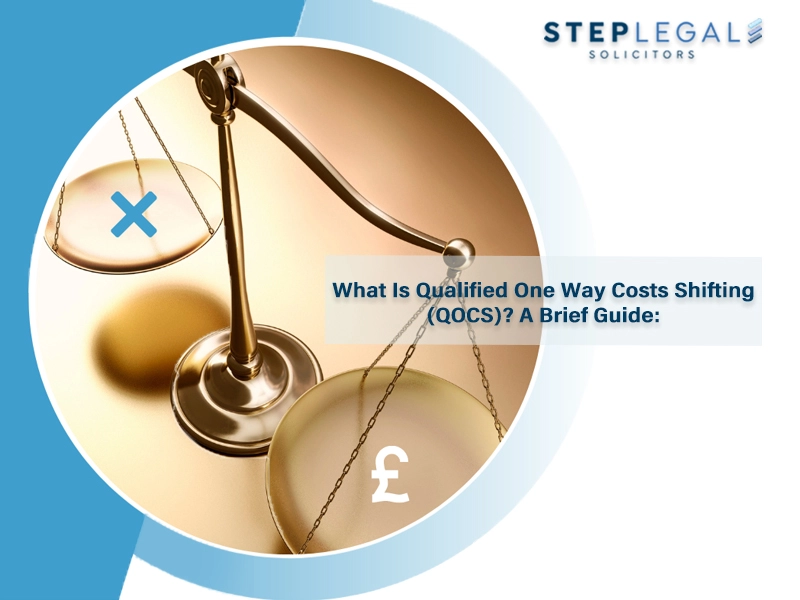
What Is Qualified One Way Costs Shifting (QOCS)? A Brief Guide
Qualified One Way Costs Shifting, usually shortened to QOCS, is a legal rule in England and Wales that helps protect people who bring personal injury or medical negligence claims from the risk of paying the other side’s legal costs if their case is unsuccessful.
In simple terms, QOCS means that if you lose a genuine personal injury claim, you will usually not have to pay the defendant’s legal costs. This protection exists to make it easier and safer for injured people to pursue compensation.
Why Does QOCS Exist?
Traditionally, the legal system in England and Wales followed the rule that the losing party pays the winning party’s legal costs. This could make people reluctant to bring a claim, especially against large organisations or public bodies, because the financial risk could be very high.
QOCS was introduced in April 2013 to reduce that risk. It forms part of wider reforms designed to improve access to justice, particularly for people who have suffered injury through no fault of their own.
How Does QOCS Work in Practice?
If Your Claim Is Unsuccessful
If you bring a personal injury or medical negligence claim and it does not succeed:
- You will usually not have to pay the defendant’s legal costs
- The defendant must normally pay their own legal fees
- You are protected even if the case goes to trial
This protection applies even if the court decides the defendant was not at fault, as long as your claim was genuine and properly conducted.
If Your Claim Is Successful
If your claim succeeds:
- The defendant will usually be ordered to pay most of your legal costs
- Any costs you are ordered to pay (for example, for interim applications) are limited by QOCS
- In some situations, costs can be deducted from your compensation, but only up to a defined limit
Can Costs Ever Be Taken from Compensation?
Yes, but there are limits.
If you are awarded compensation and the court also orders you to pay some of the defendant’s costs (for example, because you did not accept a reasonable settlement offer), those costs can usually only be taken from your damages and interest, not from your personal funds.
Importantly, you cannot be made to pay more in costs than the amount of compensation you receive.
What Types of Claims Does QOCS Apply To?
QOCS mainly applies to claims for personal injury, including:
- Road traffic accidents claim
- Accidents at work
- Slips, trips, and accidents in public places
- Medical or clinical negligence
- Fatal accident claims brought by families
As long as the claim includes compensation for physical or psychological injury, QOCS will normally apply.
Claims Where QOCS Does Not Apply
QOCS does not apply to every legal case. It generally does not cover:
- Claims for property damage only
- Business or commercial disputes
- Contract disputes without injury
- Professional negligence claims not involving injury
In these cases, the usual costs rules apply.
When Can QOCS Protection Be Lost?
Although QOCS offers strong protection, it is not absolute. There are situations where the court can remove it.
Dishonesty
If a claim is found to be fundamentally dishonest, QOCS protection can be taken away. This may happen if someone:
- Exaggerates their injuries
- Makes up symptoms
- Provides false evidence
- Brings a claim they know is largely untrue
In such cases, the claimant may be ordered to pay the defendant’s legal costs.
Failure to Accept a Reasonable Offer
If the defendant makes a formal settlement offer and the claimant rejects it, but then fails to do better at trial, the court may allow the defendant to recover some of their costs.
However, even in this situation, cost recovery is still limited by QOCS, usually to the level of the compensation awarded.
QOCS and Medical Negligence Claims
QOCS is particularly important in medical negligence cases, which are often complex and expensive to run.
Medical negligence claims usually require:
- Multiple expert reports
- Detailed medical records
- Lengthy investigations
Without QOCS, many patients would be unable to afford the risk of bringing these claims, especially against NHS organisations.
Do You Still Need Insurance If QOCS Applies?
Many people still take out After the Event (ATE) insurance, even though QOCS exists. This can cover:
- Expert fees and other expenses
- Costs risks if QOCS protection is lost
- Certain settlement-related costs
QOCS reduces risk, but it does not remove it entirely.
Why QOCS Is Important for Claimants
QOCS plays a vital role in helping injured people seek justice by:
- Reducing financial risk
- Supporting no win no fee claims
- Making the legal system more accessible
- Preventing people from being discouraged by fear of legal costs
Without QOCS, many valid claims would never be brought.
Summary
Qualified One Way Costs Shifting is a key protection for people bringing personal injury and medical negligence claims in England and Wales. It means that, in most cases, you can pursue a genuine claim without the fear of being left with a large legal bill if it does not succeed.
While there are exceptions, QOCS helps ensure that injured individuals can challenge negligence fairly and with confidence.