Injured in the Audience at a Concert or Festival? Could You Claim Compensation?
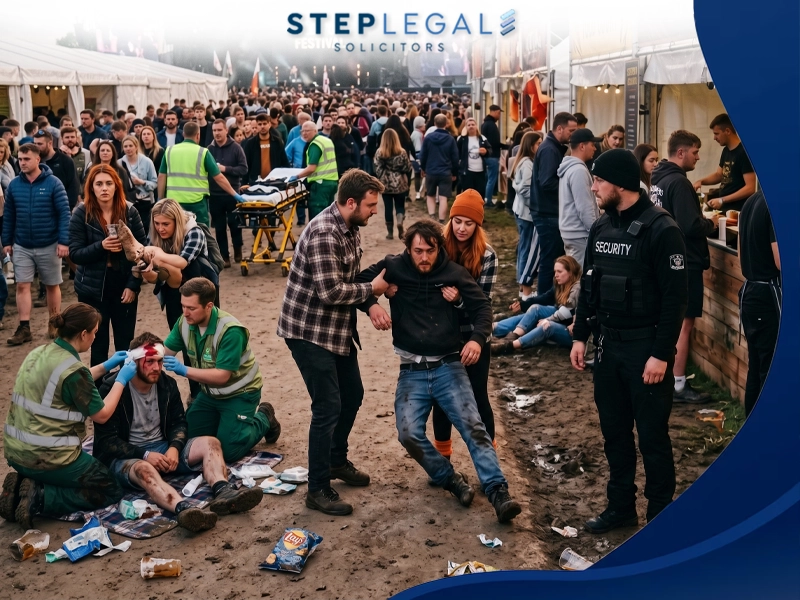
Concerts and festivals can involve large crowds, standing areas, moshing, crowd surfing, and performers interacting with the audience. While some level of physical contact may be an obvious part of attending certain events, this does not necessarily mean you have accepted every possible risk.
If you have suffered a serious injury because of a crowd crush, crowd surge, mosh pit, crowd surfer, stage diver or poor crowd management, you may have grounds to make a concert accident or festival accident personal injury claim.
Whether you can claim will depend on what happened, who was responsible, and whether reasonable steps were taken to protect you from a foreseeable risk.
What Types of Crowd Injuries Could Lead to a Claim?
Potential concert and festival injury claims can arise from:
- Crowd crushes and surges
- Being knocked over and trampled
- Being crushed against barriers
- Mosh pit injuries
- Crowd surfers falling onto you
- Performers stage diving into the audience
- Inadequate security or stewarding
- Dangerous overcrowding
- Unsafe barriers or crowd-control systems
- Poorly managed entrances and exits
- Failure to respond to a developing crowd emergency
Not every accident will result in a successful claim. The key issue is whether another party owed you a duty of care and failed to take reasonable care, causing your injury.
Who Could Be Liable for a Festival or Concert Injury?
There may be several parties potentially responsible.
The Festival or Concert Organiser
Event organisers have important responsibilities for crowd safety.
The Health and Safety Executive (HSE) identifies crowd surges, crushing against fixed structures, falls and trampling as risks that organisers should consider when assessing crowd safety. It also recommends considering the likely behaviour of the audience and the effect of the performer when planning an event.
An organiser could potentially be liable where, for example, there was:
- Excessive overcrowding
- Inadequate crowd monitoring
- Insufficient security or stewards
- Poorly designed barriers
- Inadequate emergency procedures
- A failure to respond to dangerous crowd behaviour
The Venue
The venue owner or operator may potentially be liable under the Occupiers’ Liability Act 1957.
Section 2(2) provides that an occupier generally owes visitors a duty to take reasonable care to ensure they are reasonably safe when using the premises for the purposes for which they are permitted to be there.
Responsibility can potentially be shared between a venue, promoter and event organiser depending on who had control over the relevant safety arrangements.
Security Companies and Contractors
Security and stewarding are often outsourced.
A security company could potentially be responsible if negligent crowd management contributed to an injury. However, the organiser may still have responsibilities for coordinating the overall safety arrangements.
What If You Were Injured by a Stage Diver or Crowd Surfer?
This is where liability can become particularly complicated.
Imagine a singer jumps from the stage and lands on you, causing a serious injury.
The fact that the performer physically caused the injury does not automatically establish liability. The circumstances would need to be examined, including:
- Was stage diving a known or regular part of the performance?
- Did the organiser know it was likely to happen?
- Were security staff prepared for it?
- Were appropriate barriers or safety arrangements in place?
- Was the performer’s conduct reasonably foreseeable?
The same principles can apply if a crowd surfer falls onto you.
If crowd surfing was common at the event and the organisers knew about it, this could potentially be relevant to whether the risk was foreseeable and whether reasonable precautions were taken.
That does not automatically mean the organiser was negligent — but it may warrant further investigation.
What About a Mosh Pit Injury?
A mosh pit injury claim can be more difficult because physical contact is an obvious part of moshing.
The courts have recognised that people who voluntarily participate in activities involving obvious risks may have difficulty establishing that an occupier was negligent when those risks materialise.
In Tomlinson v Congleton Borough Council [2003] UKHL 47, the House of Lords considered the extent of an occupier’s duty where a claimant voluntarily engaged in an activity involving an obvious risk. The case emphasised the importance of factors including the nature of the risk, the activity involved and whether reasonable precautions were required.
Similarly, Poppleton v Trustees of the Portsmouth Youth Activities Committee [2008] EWCA Civ 646 considered the risks voluntarily undertaken by someone participating in a recreational activity.
These cases do not mean that entering a mosh pit automatically prevents a claim.
There is an important difference between accepting and implicitly consenting to the ordinary risks of moshing and being exposed to an additional danger created by negligent event management.
For example, you may accept that moshing involves pushing and collisions. You do not necessarily accept the risk of being trapped in an excessively overcrowded area because the organiser failed to manage the crowd properly.
What Is Contributory Negligence?
Your own actions can also be relevant.
Under the Law Reform (Contributory Negligence) Act 1945, a claim is not necessarily defeated because the claimant was partly responsible for their injuries. Instead, compensation can be reduced to reflect the claimant’s share of responsibility.
For example, voluntarily entering a mosh pit and actively participating in pushing may be relevant when assessing your responsibility.
However, the situation could be very different if you were standing away from the mosh pit and were unexpectedly swept into it by a crowd surge.
The question is therefore not simply “Were you in the crowd?” but rather what happened, what risks did you know about and what did the defendant do or fail to do?
Does Going to a Concert Mean You Accept the Risk?
Not necessarily.
A defendant may argue that an injury was an obvious or inherent risk of attending the event.
However, there is a distinction between accepting an ordinary risk and accepting negligence.
The HSE’s crowd-management guidance recognises that event organisers should assess risks such as crowd density, surging, crushing, barriers, bottlenecks and the behaviour likely to be generated by particular performers.
So, while a concertgoer may understand that a standing concert involves some pushing and physical contact, that does not necessarily mean they have accepted the risk of negligent crowd management.
What Evidence Could Help With a Crowd Injury Claim?
Crowd accidents can be difficult to investigate because the event may be dismantled immediately afterwards.
If possible, preserve:
- Photographs and videos
- Your ticket and booking confirmation
- Witness details
- Medical records
- Accident reports
- Social media footage
- Photographs of barriers and crowd conditions
- Evidence of lost earnings and other financial losses
It may also be necessary to investigate evidence held by the organiser or venue, such as CCTV, incident reports, risk assessments, crowd-management plans and security records.
What Should You Do After a Concert Crowd Injury?
If you have been injured:
Report the accident to the organiser, venue or security staff where possible.
Seek medical attention, particularly if you have suffered a significant injury.
Take photographs of the location, crowd barriers and your injuries.
Record what happened while your memory is fresh.
Get witness details where possible.
Keep your ticket and event correspondence.
If you believe someone else’s negligence contributed to your injury, it can be worth obtaining legal advice before assuming the accident was simply an unavoidable part of attending the event.
Can You Claim Compensation for a Concert or Festival Crowd Injury?
Potentially.
There is no automatic rule that says someone injured at a concert is entitled to compensation. Equally, no rule attending a mosh pit, standing near the stage or buying a festival ticket means you have accepted every risk.
A claim may be worth investigating where there is evidence of:
- Dangerous overcrowding
- Poor crowd management
- Insufficient security
- Unsafe barriers
- Failure to respond to a crowd surge
- Foreseeable but inadequately managed stage diving or crowd surfing
- Other failures to take reasonable precautions
Potential defendants could include the festival organiser, promoter, venue, security company, contractor or potentially the performer, depending on the circumstances.
If you have suffered a serious injury at a concert or festival, a solicitor can investigate what happened, identify potentially responsible parties and advise whether you may have grounds for a concert injury claim or festival injury claim.
You may be able to claim compensation even if you are unsure whether you have a case at all, or don’t know who may be responsible.